Showing posts with label voc emissions. Show all posts

Monday, April 2, 2012

To Protect Americans' Health, NRDC Opposes Expanded Fracking until Stronger Safeguards Are in Place

Frances Beinecke’s Blog

April, 2 2012

Most people want their homes to be a safe haven where their families can grow and thrive. Yet for thousands of Americans who find themselves living next to natural gas drilling sites, that sense of safety is becoming harder to preserve.
A new study by researchers from the Colorado School of Public Health found that air pollution near natural gas fracking sites increased the risk of significant health problems for people living near drill sites.
The researchers detected a toxic stew of natural gas-related chemicals, including benzene, a known carcinogen, in the air. Exposure to these chemicals is linked to headaches, asthma symptoms, childhood leukemia, and multiple myeloma. They concluded that people living within a half-mile of these drill pads were at greater risk for health problems. Colorado lets companies sink wells as close as 150 feet to people’s houses.

Click image to enlarge
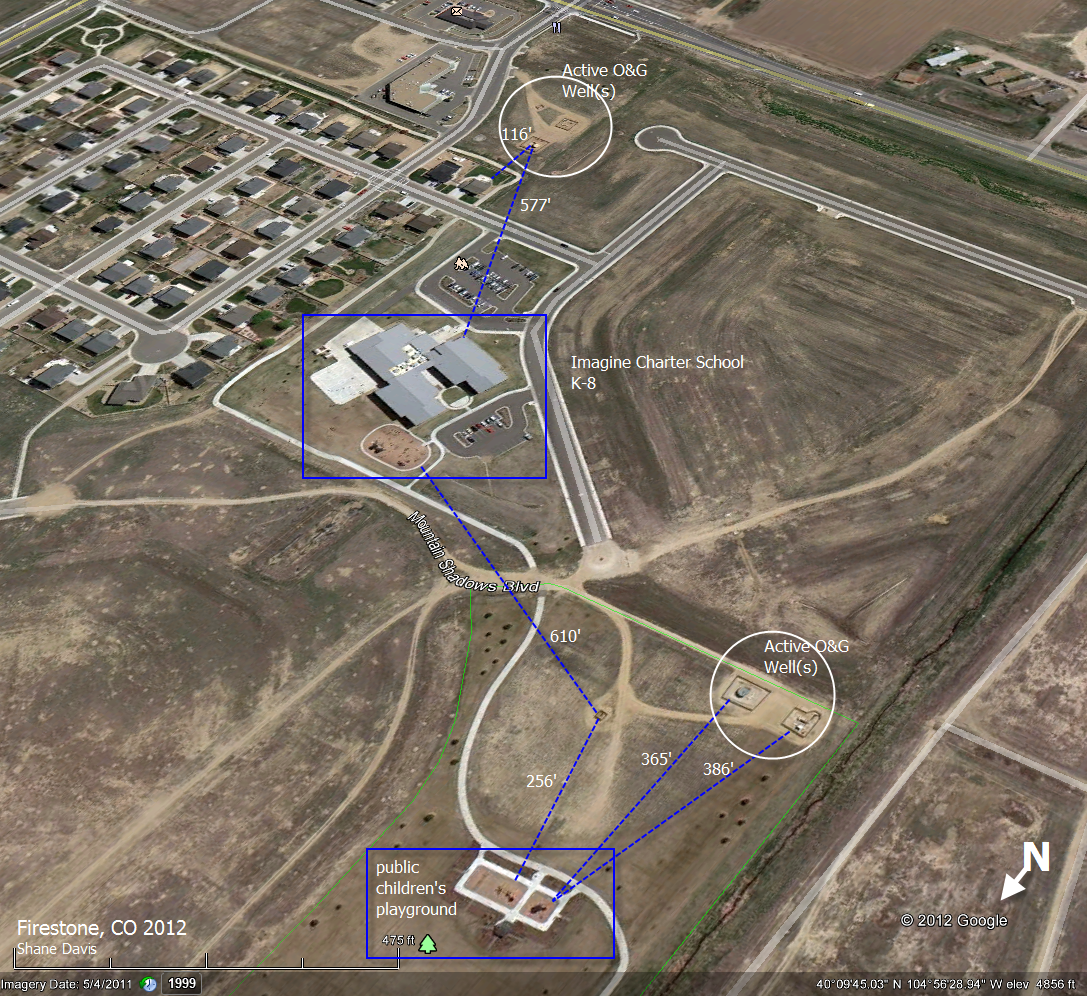
Photo credit: Shane Davis, Sierra Club, Rocky Mountain Chapter


This study confirms reports of hazardous air pollution and related health problems in communities around the country near natural gas fracking. Fracking entails mixing dangerous chemicals with large amounts of water and sand, then injecting this frack cocktail into wells at extremely high pressure in order to release natural gas reserves. This technique has allowed oil and gas companies to access previously out-of-reach reserves.
As a result, natural gas development has swept across many parts of America at break-neck speed in the past ten years. Unfortunately, federal and state safeguards to protect people and the environment from fracking have not kept pace.
Energy companies have been allowed to run roughshod over communities, leaving contaminated drinking water, dirty air, gutted property values, and greater earthquake risk in their wake. Companies don’t always play by the rules that do exist, and the industry has used its political power to escape accountability for its actions.


Continue reading...


Wednesday, November 16, 2011

The purpose of a glycol dehydration unit is to remove water from natural gas

Source: wikipedia

Glycol dehydration is a liquid desiccant system for the removal of water from natural gas and natural gas liquids (NGL). It is the most common and economic means of water removal from these streams.[1] Glycols typically seen in industry include triethylene glycol (TEG), diethylene glycol (DEG), ethylene glycol (MEG), and tetraethylene glycol (TREG). TEG is the most commonly used glycol in industry.[1]
An example process flow diagram for this system is shown below:


Purpose

The purpose of a glycol dehydration unit is to remove water from natural gas and natural gas liquids. When produced from a reservoir, natural gas usually contains a large amount of water and is typically completely saturated or at the water dew point. This water can cause several problems for downstream processes and equipment. At low temperatures the water can either freeze in piping or, as is more commonly the case, form hydrates with CO2 and hydrocarbons (mainly methane hydrates). Depending on composition, these hydrates can form at relatively high temperatures plugging equipment and piping.[1] Glycol dehydration units depress the hydrate formation point of the gas through water removal.


Without dehydration, a free water phase (liquid water) could also drop out of the natural gas as it is either cooled or the pressure is lowered through equipment and piping. This free water phase will contain some portions of acid gas (such as H2S and CO2) and can cause corrosion.[1]


For the above two reasons the Gas Processors Association sets out a pipeline quality specification for gas that the water content should not exceed 7 pounds per million cubic feet . [1] Glycol dehydration units must typically meet this specification at a minimum, although further removal may be required if additional hydrate formation temperature depression is required, such as upstream of a cryogenic process or gas plant.

Process description

Lean, water-free glycol (purity >99%) is fed to the top of an absorber (also known as a "glycol contactor") where it is contacted with the wet natural gas stream. The glycol removes water from the natural gas by physical absorption and is carried out the bottom of the column. Upon exiting the absorber the glycol stream is often referred to as "rich glycol". The dry natural gas leaves the top of the absorption column and is fed either to a pipeline system or to a gas plant. Glycol absorbers can be either tray columns or packed columns.


Continue reading...

CAST YOUR VOTE