FOR IMMEDIATE RELEASE
July 13, 2011
Contact:
Virginia Cramer, 804-225-9113 x102
Washington, DC -- In a 239 to 184 vote, the U.S. House of Representatives today voted for legislation that threatens the safety of the lakes and rivers that provide much of our nation's drinking water. Sponsored by Reps. John Mica (FL) and Nick Rahall (WV), H.R. 2018 guts the Clean Water Act, severely limits the federal government’s ability to protect waterways, and seeks to return the country to an era of inconsistent and ineffective state water safety standards without a federal safety net. Representatives also voted against an amendment that would have ensured continued protection of municipal drinking water sources.
In response, Sierra Club Executive Director Michael Brune issued the following statement.
"Today's unprecedented attack on clean water protections is an assault on Americans' health, environment and economy – and further exposes a House of Representatives that no longer represents the interests or the values of the American people. "
We applaud President Obama for his strong support of clean water protections for our families. We should all be able to eat the fish we catch, swim in our lakes and drink from our taps without fear of getting sick.
The federal safety net that Congress created when it passed the Clean Water Act has stopped billions of pounds of pollution from entering our waters and doubled the number of waterways that meet clean water standards.
Without it, cities would still be dumping untreated sewage into waterways every day and industries would still be using rivers for waste disposal. Lake Erie would still be 'dead.'
But the work of cleaning up our waters is far from over. There are still too many places where water is not safe for fishing and swimming. Now is not the time to roll back essential clean water protections or prevent the Environmental Protection Agency from protecting Americans’ drinking water."
###
H.R. 2018 would:
- Thwart states from protecting their drinking water sources and other waters from pollution discharges from upstream or neighboring states.
- Prevent the Environmental Protection Agency, without state concurrence, from taking action to revise outdated state water quality standards, making it easier for companies to dump their waste and garbage into lakes and rivers.
- Eliminate the federal safety net ensuring that states update their water quality standards as scientific understanding evolves.
- Allow states failing to meet minimal federal clean water standards to continue receiving federal taxpayer funding for inadequate programs.
- Prevent the EPA from intervening in the most destructive proposed waste-dumping permits and projects that would threaten drinking water supplies, fisheries, wildlife and recreational areas at an unacceptable level. The EPA has exercised this authority only 13 times in the history of the Clean Water Act-- most recently prohibiting a mine waste dump that would have filled six miles of Appalachian streams.

Showing posts with label OBAMA ON HYDROFRACKING. Show all posts
Showing posts with label OBAMA ON HYDROFRACKING. Show all posts
Thursday, July 14, 2011


Tuesday, May 10, 2011
Obama Taps Panel of Experts to Make Hydrofracking Cleaner, Safer
Posted by Josh Garrett on May 10, 2011 at 4:06 pm

Following up on the vision of wider but more cautious tapping of America’s vast natural gas reserves that he laid out in March, President Obama has called on a group of experts to explore how to make gas drilling safer. The New York Times reported on Friday that the Department of Energy, at the direction of the president, has convened a diverse panel of experts to come up with solutions to the threat hydraulic fracturing (a.k.a. hydrofracking) poses to underground sources of drinking water.
Hydrofracking has been identified as the key to accessing decades’ worth of natural gas supplies currently locked beneath rock formations in the eastern and western US. As the use of fracking has expanded rapidly in recent years, so has domestic natural gas production. And because propane and other NGLs are byproducts of gas drilling, increased gas extraction has boosted propane supplies substantially. But because it involves blasting millions of gallons of toxic chemicals into the ground at extremely high pressure, hydrofracking has been linked to contamination of rural water supplies. Those cases and the ongoing danger of soil and water pollution have spawned a movement led by environmentalists to halt hydrofracking until it can be more completely and effectively regulated to protect local environments.
The movement to regulate fracking has found a receptive audience in the Obama administration, with both Obama himself and Secretary of Energy Steven Chu publicly stating the need for more investigation into and oversight of fracking activities. The panel named by Secretary Chu last week has two objectives: to recommend steps that will make hydrofracking safer in just 90 days and to outline appropriate safety and environmental guidelines for state and federal regulators. The seven-member panel is led by John Deutch, a chemist and former director of the Central Intelligence Agency, and includes oil and gas industry leaders, academics, and environmentalists.
Despite the diverse makeup of the panel that represents all stakeholders in the fracking debate, Republicans in the House of Representatives swiftly condemned the creation of the panel and its mission in a press release, claiming further studies of hydrofracking are superfluous and place an undue burden on businesses. Republicans also stated that hydrofracking has been used safely for decades and that the Evironmental Protection Agency already has sufficient authority to regulate the practice.
While hydrofracking has been employed by the oil and gas industry for more than 50 years, recent technological advancements like horizontal drilling have allowed fracking to be used in ever-deeper drilling endeavors, bringing about new threats to aquifers and surrounding environments.

Former CIA director John Deutch will lead a panel of experts in seeking out solutions to the safety and environmental threats posed by hydraulic fracturing. (image: darkgovernment.com)
Hydrofracking has been identified as the key to accessing decades’ worth of natural gas supplies currently locked beneath rock formations in the eastern and western US. As the use of fracking has expanded rapidly in recent years, so has domestic natural gas production. And because propane and other NGLs are byproducts of gas drilling, increased gas extraction has boosted propane supplies substantially. But because it involves blasting millions of gallons of toxic chemicals into the ground at extremely high pressure, hydrofracking has been linked to contamination of rural water supplies. Those cases and the ongoing danger of soil and water pollution have spawned a movement led by environmentalists to halt hydrofracking until it can be more completely and effectively regulated to protect local environments.
The movement to regulate fracking has found a receptive audience in the Obama administration, with both Obama himself and Secretary of Energy Steven Chu publicly stating the need for more investigation into and oversight of fracking activities. The panel named by Secretary Chu last week has two objectives: to recommend steps that will make hydrofracking safer in just 90 days and to outline appropriate safety and environmental guidelines for state and federal regulators. The seven-member panel is led by John Deutch, a chemist and former director of the Central Intelligence Agency, and includes oil and gas industry leaders, academics, and environmentalists.
Despite the diverse makeup of the panel that represents all stakeholders in the fracking debate, Republicans in the House of Representatives swiftly condemned the creation of the panel and its mission in a press release, claiming further studies of hydrofracking are superfluous and place an undue burden on businesses. Republicans also stated that hydrofracking has been used safely for decades and that the Evironmental Protection Agency already has sufficient authority to regulate the practice.
While hydrofracking has been employed by the oil and gas industry for more than 50 years, recent technological advancements like horizontal drilling have allowed fracking to be used in ever-deeper drilling endeavors, bringing about new threats to aquifers and surrounding environments.
Thursday, March 3, 2011
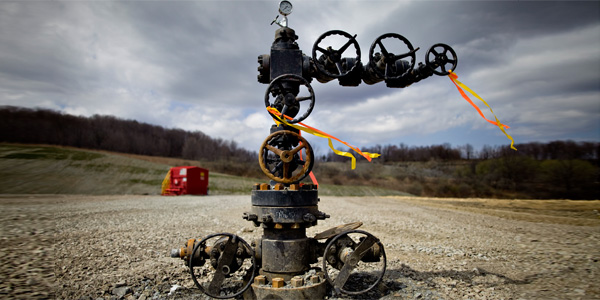
Fracking: The Great Shale Gas Rush
Natural gas derived from the process is lifting the economy, but it's environmentally risky

By Jim Efstathiou Jr. and Kim Chipman
The Pennsylvania homes of Karl Wasner and Arline LaTourette both sit atop the Marcellus Shale, a geologic formation that stretches from Tennessee to New York and holds vast deposits of natural gas. They also sit on opposite sides of a national debate over hydraulic fracturing, or fracking. That's the process that makes it economical for energy companies to tunnel 5,000 feet below ground and remove the gas—but also poses environmental risks.
Wasner settled 14 years ago in Milanville, in the state's northeast corner, and will leave if drilling companies set up derricks nearby. He already moved away for six weeks last year while an exploratory well was drilled nearby. The noise, muddy water pouring from his taps, and chemicals that turned up in a neighbor's well drove him off, he says. "I moved to a beautiful rural residential area," says Wasner, "not an industrial park."
LaTourette, whose roots in the area go back five generations, is banking on the drilling. Her family has leased almost 700 acres of farmland to Hess (HES) and other companies to tap into the Marcellus Shale. She won't say what she's getting, but signing bonuses can range from $2,000 to $5,000 an acre, and royalty payments are about 20 percent of the value of the gas produced.
President Barack Obama enthusiastically backs gas drilling, and these days 90 percent of it is done by fracking, which involves forcing below ground chemically treated water under high pressure to smash through layers of rock, thus freeing the gas to flow upward. Along with wind, solar, and nuclear power, natural gas is crucial to Obama's goal of producing 80 percent of electricity from clean energy sources by 2035. But the drilling is taking place with minimal oversight from the U.S. Environmental Protection Agency. State and regional authorities are trying to write their own rules—and having trouble keeping up.
Now, reports of contaminated water and alleged disposal of carcinogens in rivers have caught state and federal regulators, and even environmental watchdogs, off guard. Sometimes the fracking mix includes diesel fuel. Between 2005 and 2009, drillers injected 32 million gallons of fluids containing diesel into wells in 19 states, an investigation by Representative Henry A. Waxman (D-Calif.) concludes. Just as it recovers its footing from the 2010 Gulf of Mexico oil spill, the Administration faces a new threat, again involving a risky drilling technology and charges of lax regulation. Obama is "evaluating the need for new safeguards for drilling," says White House spokesman Clark W. Stevens. "It's likely that the science is going to say we need to regulate fracking," says Tyson Slocum, director of the energy program for Public Citizen, a liberal advocacy group. "But Obama's political team is going to say don't regulate, and I think the political team will win."
The Marcellus Shale may contain 490 trillion cubic feet of gas—enough to heat U.S. homes and power electric plants for two decades, says Terry Engelder, professor of geosciences at Pennsylvania State University. That makes it the world's second-largest gas field behind South Pars, shared by Iran and Qatar. The shale gas rush is creating thousands of jobs and reviving the economy in states such as Wyoming, Texas, and Louisiana. In Pennsylvania, where 2,516 wells have been drilled in the last three years, $389 million in tax revenue and 44,000 jobs came from gas drilling in 2009, according to a Penn State report. Perhaps best of all, natural gas emits half the carbon emissions of oil.
While there have been no documented cases of fracking fluids flowing underground into drinking water, there have been spills above ground. Fracking produces millions of gallons of wastewater; some of it containing benzene has spilled from holding tanks. The wastewater can overwhelm treatment plants not equipped to handle high levels of contaminants. A Feb. 26 New York Times article, using documents from the EPA and state regulators, described how radioactive wastewater is being discharged into river basins. Sierra Club Deputy Executive Director Bruce Hamilton says Obama "has been sold a bill of goods." But even the Sierra Club has struggled with fracking. Last year it overruled New York and Pennsylvania chapters calling for a national fracking ban; now it's reconsidering that decision, Hamilton says.
The Delaware River Basin Commission, which manages the watershed that supplies drinking water to 15 million people in New York, Pennsylvania, New Jersey, and Delaware, has put gas development on hold while it drafts rules. Wasner and LaTourette were among scores of people to comment at a Feb. 22 hearing in Honesdale, Pa., on a commission proposal to regulate the drilling. New York also has fracking on hold while it develops a drilling playbook. The Marcellus Shale runs beneath the watershed that supplies just over 1 billion gallons of water a day to New York City, the U.S.'s largest unfiltered water system.
The White House has sent mixed signals. "It's not necessarily federal regulation that will be needed," EPA Administrator Lisa P. Jackson told a Feb. 3 Senate hearing, noting that many communities and states already monitor parts of the process. Energy Secretary Steven Chu seems to differ. In a 2010 speech, he said fracking can be "polluting" and that rules were inevitable. "We continue to believe that state regulatory agencies have the appropriate expertise" to oversee gas production, says Dan Whitten, a spokesman for America's Natural Gas Alliance.
Even if the EPA stepped in, its authority would be limited. A clause in a 2005 energy law—dubbed the "Halliburton (HAL) loophole" for the company that helped pioneer fracking and is a supplier of fracking fluids—exempts fracking from parts of the Safe Drinking Water Act. Representative Maurice Hinchey (D-N.Y.) says Dick Cheney, once head of Halliburton, pushed for the exemption when he was Vice-President. Hinchey's evidence is circumstantial: Fracking was endorsed in Cheney's 2001 energy task force report, which led to the 2005 law and, according to Waxman, did not reflect the EPA's initial concerns about water pollution. Cheney declined to comment. Halliburton referred a request for comment to its website, which doesn't discuss fracking's risks.
So far, the EPA has begun a study of fracking's effect on drinking water. In February the agency said final results will come in 2014, two years after its initial target—and the 2012 elections. Its emphasis is "politics first and regulation second," says Kevin Book, managing director at ClearView Energy Partners, a Washington policy group. "It's impossible to miss the jobs power of fracking in the Marcellus."
The bottom line: The Obama Administration may need to rethink its hands-off policy on fracking, despite the national job and energy benefits.
By Jim Efstathiou Jr. and Kim Chipman
The Pennsylvania homes of Karl Wasner and Arline LaTourette both sit atop the Marcellus Shale, a geologic formation that stretches from Tennessee to New York and holds vast deposits of natural gas. They also sit on opposite sides of a national debate over hydraulic fracturing, or fracking. That's the process that makes it economical for energy companies to tunnel 5,000 feet below ground and remove the gas—but also poses environmental risks.
Wasner settled 14 years ago in Milanville, in the state's northeast corner, and will leave if drilling companies set up derricks nearby. He already moved away for six weeks last year while an exploratory well was drilled nearby. The noise, muddy water pouring from his taps, and chemicals that turned up in a neighbor's well drove him off, he says. "I moved to a beautiful rural residential area," says Wasner, "not an industrial park."
LaTourette, whose roots in the area go back five generations, is banking on the drilling. Her family has leased almost 700 acres of farmland to Hess (HES) and other companies to tap into the Marcellus Shale. She won't say what she's getting, but signing bonuses can range from $2,000 to $5,000 an acre, and royalty payments are about 20 percent of the value of the gas produced.
President Barack Obama enthusiastically backs gas drilling, and these days 90 percent of it is done by fracking, which involves forcing below ground chemically treated water under high pressure to smash through layers of rock, thus freeing the gas to flow upward. Along with wind, solar, and nuclear power, natural gas is crucial to Obama's goal of producing 80 percent of electricity from clean energy sources by 2035. But the drilling is taking place with minimal oversight from the U.S. Environmental Protection Agency. State and regional authorities are trying to write their own rules—and having trouble keeping up.
Now, reports of contaminated water and alleged disposal of carcinogens in rivers have caught state and federal regulators, and even environmental watchdogs, off guard. Sometimes the fracking mix includes diesel fuel. Between 2005 and 2009, drillers injected 32 million gallons of fluids containing diesel into wells in 19 states, an investigation by Representative Henry A. Waxman (D-Calif.) concludes. Just as it recovers its footing from the 2010 Gulf of Mexico oil spill, the Administration faces a new threat, again involving a risky drilling technology and charges of lax regulation. Obama is "evaluating the need for new safeguards for drilling," says White House spokesman Clark W. Stevens. "It's likely that the science is going to say we need to regulate fracking," says Tyson Slocum, director of the energy program for Public Citizen, a liberal advocacy group. "But Obama's political team is going to say don't regulate, and I think the political team will win."
The Marcellus Shale may contain 490 trillion cubic feet of gas—enough to heat U.S. homes and power electric plants for two decades, says Terry Engelder, professor of geosciences at Pennsylvania State University. That makes it the world's second-largest gas field behind South Pars, shared by Iran and Qatar. The shale gas rush is creating thousands of jobs and reviving the economy in states such as Wyoming, Texas, and Louisiana. In Pennsylvania, where 2,516 wells have been drilled in the last three years, $389 million in tax revenue and 44,000 jobs came from gas drilling in 2009, according to a Penn State report. Perhaps best of all, natural gas emits half the carbon emissions of oil.
While there have been no documented cases of fracking fluids flowing underground into drinking water, there have been spills above ground. Fracking produces millions of gallons of wastewater; some of it containing benzene has spilled from holding tanks. The wastewater can overwhelm treatment plants not equipped to handle high levels of contaminants. A Feb. 26 New York Times article, using documents from the EPA and state regulators, described how radioactive wastewater is being discharged into river basins. Sierra Club Deputy Executive Director Bruce Hamilton says Obama "has been sold a bill of goods." But even the Sierra Club has struggled with fracking. Last year it overruled New York and Pennsylvania chapters calling for a national fracking ban; now it's reconsidering that decision, Hamilton says.
The Delaware River Basin Commission, which manages the watershed that supplies drinking water to 15 million people in New York, Pennsylvania, New Jersey, and Delaware, has put gas development on hold while it drafts rules. Wasner and LaTourette were among scores of people to comment at a Feb. 22 hearing in Honesdale, Pa., on a commission proposal to regulate the drilling. New York also has fracking on hold while it develops a drilling playbook. The Marcellus Shale runs beneath the watershed that supplies just over 1 billion gallons of water a day to New York City, the U.S.'s largest unfiltered water system.
The White House has sent mixed signals. "It's not necessarily federal regulation that will be needed," EPA Administrator Lisa P. Jackson told a Feb. 3 Senate hearing, noting that many communities and states already monitor parts of the process. Energy Secretary Steven Chu seems to differ. In a 2010 speech, he said fracking can be "polluting" and that rules were inevitable. "We continue to believe that state regulatory agencies have the appropriate expertise" to oversee gas production, says Dan Whitten, a spokesman for America's Natural Gas Alliance.
Even if the EPA stepped in, its authority would be limited. A clause in a 2005 energy law—dubbed the "Halliburton (HAL) loophole" for the company that helped pioneer fracking and is a supplier of fracking fluids—exempts fracking from parts of the Safe Drinking Water Act. Representative Maurice Hinchey (D-N.Y.) says Dick Cheney, once head of Halliburton, pushed for the exemption when he was Vice-President. Hinchey's evidence is circumstantial: Fracking was endorsed in Cheney's 2001 energy task force report, which led to the 2005 law and, according to Waxman, did not reflect the EPA's initial concerns about water pollution. Cheney declined to comment. Halliburton referred a request for comment to its website, which doesn't discuss fracking's risks.
So far, the EPA has begun a study of fracking's effect on drinking water. In February the agency said final results will come in 2014, two years after its initial target—and the 2012 elections. Its emphasis is "politics first and regulation second," says Kevin Book, managing director at ClearView Energy Partners, a Washington policy group. "It's impossible to miss the jobs power of fracking in the Marcellus."
The bottom line: The Obama Administration may need to rethink its hands-off policy on fracking, despite the national job and energy benefits.
Efstathiou is a reporter for Bloomberg News.Chipman is a reporter for Bloomberg News.
Bloomberg Businessweek - Politics & Policy March 3, 2011, 5:00PM EST
Subscribe to:
Posts (Atom)