electcarlberickson/

Showing posts with label Fracking in Weld County. Show all posts
Showing posts with label Fracking in Weld County. Show all posts
Saturday, August 25, 2012
Open letter to the Honorable John Hickenlooper, Governor State of Colorado


Monday, April 2, 2012
To Protect Americans' Health, NRDC Opposes Expanded Fracking until Stronger Safeguards Are in Place
Frances Beinecke’s Blog
April, 2 2012
Most people want their homes to be a safe haven where their families can grow and thrive. Yet for thousands of Americans who find themselves living next to natural gas drilling sites, that sense of safety is becoming harder to preserve.
A new study by researchers from the Colorado School of Public Health found that air pollution near natural gas fracking sites increased the risk of significant health problems for people living near drill sites.
The researchers detected a toxic stew of natural gas-related chemicals, including benzene, a known carcinogen, in the air. Exposure to these chemicals is linked to headaches, asthma symptoms, childhood leukemia, and multiple myeloma. They concluded that people living within a half-mile of these drill pads were at greater risk for health problems. Colorado lets companies sink wells as close as 150 feet to people’s houses.
Click image to enlarge
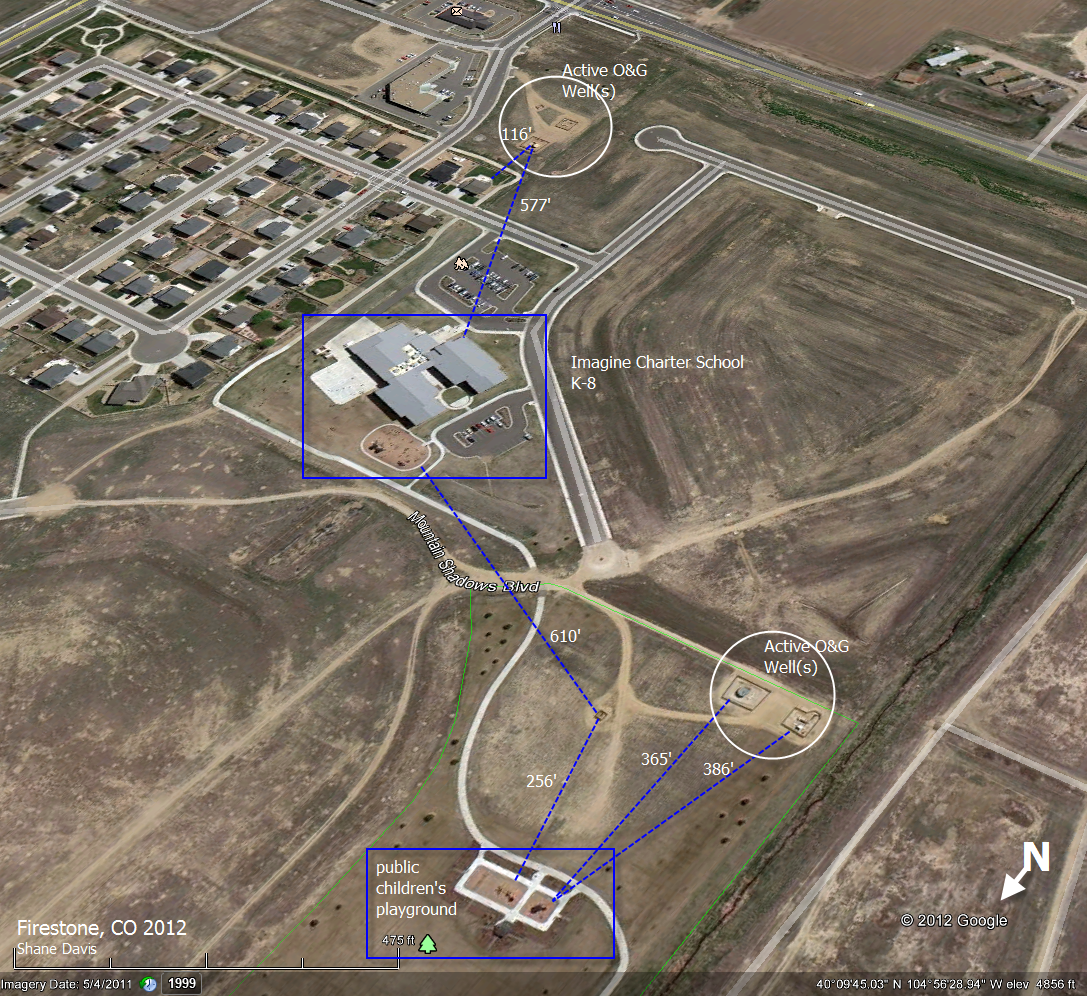 |
| Photo credit: Shane Davis, Sierra Club, Rocky Mountain Chapter |
This study confirms reports of hazardous air pollution and related health problems in communities around the country near natural gas fracking. Fracking entails mixing dangerous chemicals with large amounts of water and sand, then injecting this frack cocktail into wells at extremely high pressure in order to release natural gas reserves. This technique has allowed oil and gas companies to access previously out-of-reach reserves.
As a result, natural gas development has swept across many parts of America at break-neck speed in the past ten years. Unfortunately, federal and state safeguards to protect people and the environment from fracking have not kept pace.
Energy companies have been allowed to run roughshod over communities, leaving contaminated drinking water, dirty air, gutted property values, and greater earthquake risk in their wake. Companies don’t always play by the rules that do exist, and the industry has used its political power to escape accountability for its actions.Continue reading...
Thursday, December 8, 2011
Hydrogen sulfide high at 53 wells, Noble says
By Dennis Webb
Wednesday, December 7, 2011
 Noble Energy is reporting dangerous levels of hydrogen sulfide gas have been measured at least once at dozens of its wells not just in Garfield County, but Weld County as well.
Continue reading...
.....................................................................................
H2S Safety Factsheet
source:SafetyDirectory.com
Wednesday, December 7, 2011

The company says 21 of its wells in the Piceance Basin have had levels at or above 100 parts per million on at least one occasion, as have 32 wells in the Grover oil and gas field in Weld County.
Short-term exposures at such levels can cause several health problems, and exposures lasting hours can cause death. But Noble Energy says safety protocols are in place to protect workers.
Noble Energy reported its findings as part of a response to allegations by state regulators that it failed to comply with requirements to report hydrogen sulfide gas encountered at oil and gas sites in the two counties.
Noble Energy also reported lower levels of hydrogen sulfide at eight of its wells in Mesa County, several miles south of Parachute. Noble Energy spokesman Stephen Flaherty said gas chromatograph tests at those sites all found levels less than two parts per million. The highest reading for any of those wells was 50 ppm, using a less accurate test designed simply to confirm the presence of the gas for the sake of workers, he said.
Bureau of Land Management spokesman David Boyd said that when Noble Energy has experienced hydrogen sulfide at federal well pads in the Piceance, it hasn’t been in the natural gas itself, but in liquids at the sites, and it has been associated with some wells on a pad but not others. That suggests it was introduced, he said.
Continue reading...
.....................................................................................
H2S Safety Factsheet
Hydrogen sulfide (H2S, CAS# 7783-06-4) is an extremely hazardous, toxic compound. It is a colorless, flammable gas that can be identified in relatively low concentrations, by a characteristic rotten egg odor. The gas occurs naturally in coal pits, sulfur springs, gas wells, and as a product of decaying sulfur-containing organic matter, particularly under low oxygen conditions.
It is therefore commonly encountered in places such as sewers, sewage treatment plants (H2S is often called sewer gas), manure stockpiles, mines, hot springs, and the holds of fishing ships. Industrial sources of hydrogen sulfide include petroleum and natural gas extraction and refining, pulp and paper manufacturing, rayon textile production, leather tanning, chemical manufacturing and waste disposal.
Hydrogen sulfide has a very low odor threshold, with its smell being easily perceptible at concentrations well below 1 part per million (ppm) in air. The odor increases as the gas becomes more concentrated, with the strong rotten egg smell recognizable up to 30 ppm. Above this level, the gas is reported to have a sickeningly sweet odor up to around 100 ppm.
However, at concentrations above 100 ppm, a person's ability to detect the gas is affected by rapid temporary paralysis of the olfactory nerves in the nose, leading to a loss of the sense of smell. This means that the gas can be present at dangerously high concentrations, with no perceivable odor.
Prolonged exposure to lower concentrations can also result in similar effects of olfactory fatigue. This unusual property of hydrogen sulfide makes it extremely dangerous to rely totally on the sense of smell to warn of the presence of the gas.
Health Effects of Hydrogen Sulfide
H2S is classed as a chemical asphyxiant, similar to carbon monoxide and cyanide gases. It inhibits cellular respiration and uptake of oxygen, causing biochemical suffocation. Typical exposure symptoms include:
| O W | 0 - 10 ppm | Irritation of the eyes, nose and throat |
| O D | 10 - 50 ppm | Headache Dizziness Nausea and vomiting Coughing and breathing difficulty |
| I G H | 50 - 200 ppm | Severe respratory tract irritation Eye irritation / acute conjunctivitis Shock Convulsions Coma Death in severe cases |
Prolonged exposures at lower levels can lead to bronchitis, pneumonia, migraine headaches, pulmonary edema, and loss of motor coordination.
Working with Hydrogen Sulfide
Most countries have legal limits in force that govern the maximum allowable levels of exposure to hydrogen sulfide in the working environment. A typical permissible exposure limit in many countries is 10 ppm. While the distinctive odor of H2S is easily detected, its olfactory fatigue effects mean that one cannot rely on the nose as a warning device. The only reliable way to determine exposure levels is to measure the amount in the air. Regular monitoring will help to identify areas and operations likely to exceed permissible exposure limits, and any areas that routinely pose overexposure hazards should be equipped with continuous monitoring systems.
With a vapor density of 1.19, hydrogen sulfide is approximately 20 percent heavier than air, so this invisible gas will collect in depressions in the ground and in confined spaces. The use of direct reading gas detection instrumentation should be required before entering confined spaces such as manholes, tanks, pits, and reaction vessels that could contain an accumulation of H2S gas.
Wherever possible, exposure should be minimized by employing adequate engineering controls and safe working practices. Such methods include ensuring good ventilation and changing work procedures and practices. Where engineering controls cannot adequately control levels of exposure, it may be necessary to supplement them with the use of suitable personal protective equipment (PPE) such as supplied-air respirators. A qualified industrial hygienist or safety professional should be consulted for guidance on the suitability and correct use of respirators.
Should a co-worker ever be overcome by H2S gas, do not attempt a rescue until you are properly protected yourself. The rescuer can very easily get caught out by venturing into a confined space without adequate protection. Remember that at levels above 200 ppm, collapse, coma and death due to respiratory failure can occur within seconds after only a few inhalations so you can be overcome yourself very quickly. Such incidents are sadly all too common and only serve to make the rescue effort twice as difficult.
source:SafetyDirectory.com
Subscribe to:
Posts (Atom)