Showing posts with label NRDC. Show all posts

Friday, May 4, 2012

FOR IMMEDIATE RELEASE: Environmental Groups Call on EPA to Ban Diesel Use in Fracking


FOR IMMEDIATE RELEASE
Friday, May 4, 2012
Contact:
Jason Pitt, Sierra Club, 202.675.6272


Environmental Groups Call on EPA to Ban Diesel Use in Fracking

Washington, D.C. — National environmental groups today called on the Environmental Protection Agency to ban the use of diesel in hydraulic fracturing or ‘fracking’ fluids, instead of issuing guidance for regulating the practice, following the agency’s release of draft guidance.  Diesel is currently used in fracking chemical cocktails and poses serious risks to drinking water sources.  EPA guidance  is not enough to protect families from benzene and other highly toxic chemicals contaminating underground drinking water sources. 

The Energy Policy Act of 2005 exempted hydraulic fracturing from the Safe Drinking Water Act (SDWA) in the Halliburton Loophole—except when diesel is used.  Recent Congressional investigations revealed diesel use in fracking fluids remains widespread.   This EPA action provides guidance for using the Safe Drinking Water Act’s Underground Injection Control Program to protect underground sources of drinking water.  The EPA announced a 60-day public comment period on the proposal. 

The use of diesel in fracking fluid is just one of many harmful industry practices that the government must clean up. Strong federal protections are needed to protect American families nationwide from all of the consequences of dirty fracking.

In response leaders from the environmental organizations calling for a ban on diesel used in fracking, released the following statements:

“It’s no secret that diesel is dirty and dangerous, and belongs nowhere near our drinking water.  But the natural gas industry has been using this dangerous fuel for fracking, showing once again that they cannot be trusted to police themselves.  We urge the EPA to ban diesel fracking and keep Americans’ drinking water clean and safe.”  - Michael Brune, Executive Director of the Sierra Club

“We applaud EPA’s action and urge the Agency to use their authority to ban diesel use and to do whatever is necessary to protect precious underground drinking water sources from chemical contamination.”  - Bob Wendelgass, President of Clean Water Action

“Diesel and drinking water don't mix. Congress recognized the hazards of diesel when they passed the Halliburton loophole to the Safe Drinking Water Act. We welcome EPA's action; it's time for the oil and gas industry to clean up their act.” - Jennifer Krill, Executive Director of Earthworks

“Diesel fuel is not critical to fracking—with the safety threats it poses, there is no sense in allowing it to be used.  We need stronger safeguards on the books to protect American health and communities from diesel threats to clean drinking water and other risks associated with fracking.” - Amy Mall, Senior Policy Analyst for the Natural Resources Defense Council

“Nobody wants to drink diesel-infused tap water. That’s why the oil and gas industry needs to stop pumping diesel underground during fracking. The risk to drinking water sources is too high and the oil and gas industry’s track record is too dismal. The EPA can and must ban this reckless practice.” - Jessica Ennis, Legislative Representative for Earthjustice

# # #

Thursday, May 3, 2012

FOR IMMEDIATE RELEASE: Fracking has contaminated a drinking water source, expert says


FOR IMMEDIATE RELEASE
April 18, 2012

Media Contacts:

Kate Slusark, NRDC, 212-727-4592 or kslusark@nrdc.org
Connie Wilbert, Sierra Club Wyoming Chapter, 307-742-0056 or connie.wilbert@sierraclub.org
Gwen Lachelt, Earthworks’ Oil & Gas Accountability Project, 970-259-3353 x1 or gwen@earthworksaction.org
Steve Jones, Wyoming Outdoor Council watershed protection program attorney, 307-332-7031 x12, steve@wyomingoutdoorcouncil.org

Fracking has contaminated a drinking water source, expert says


Independent scientist says the EPA's conclusion is 'sound' — gas drilling has 'clearly' tainted a Pavillion, Wyoming area aquifer

Pavillion, Wyo. — Hydraulic fracturing, or fracking, has clearly contaminated a drinking water source east of the town of Pavillion, Wyoming, according to a report from an independent scientist released today, supporting the draft findings of an Environmental Protection Agency (EPA) investigation published in December. Hydrologist Tom Myers reviewed the EPA’s draft report at the request of the Natural Resources Defense Council, Wyoming Outdoor Council, Sierra Club and Oil and Earthworks’ Oil & Gas Accountability Project.

"It is clear that hydraulic fracturing has polluted the groundwater of Pavillion with contaminants associated with the fracking process," said Tom Myers, a highly regarded expert in hydrology and hydrogeology, and independent consultant for industry, government and environmental groups. "The EPA’s conclusion is sound."

The formation containing gas in Pavilion contains 169 gas wells, yet the formation is part of an underground source of drinking water. As a result, fracking fluid is being injected directly into an underground source of drinking water, according to the EPA.

Myers found that the Pavillion-area groundwater was especially vulnerable to contamination from fracking and gas drilling because of the area's geology, the well designs that were used, and the fact that the construction of the gas wells was inadequate to protect the aquifer. Any of these factors could contribute to the contamination found in the monitoring and water wells. Therefore, unless fracking is done very carefully in the area, contamination is likely, according to Myers.

“This confirms EPA’s preliminary conclusion that hydraulic fracturing can and does pollute groundwater,” said Earthworks’ Oil & Gas Accountability Project Director Gwen Lachelt. “Communities around the country should take heed. Although different gas plays have different geology, if fracking can pollute groundwater here, it can happen elsewhere.”

“Americans shouldn’t have to trade their safe drinking water for fuel,” said Amy Mall of the Natural Resources Defense Council. “These findings just confirm the need to get critical safeguards on the books that protect American’s basic rights – clean water and clean air.”

"Fracking is a dirty process and as Dr. Myers' findings show, one that can put our drinking water at risk," said Connie Wilbert of Sierra Club's Wyoming Chapter.  "If families don’t have clean water, what are they left with?  Is corporate profit really worth more than a safe, clean place to live?”

Steve Jones, Watershed Protection Program Attorney for Wyoming Outdoor Council said he is concerned about best management practices. 

"Sporadic bonding was reported for 12 of the wells for which EPA had well bore data made available to them," Jones said. "If this is representative of the entire field, chances are that hydraulic fracturing contaminants from the gas wells will get to the water wells of many rural Pavillion residents."

        
###

Thursday, April 12, 2012

Fracking Fumes: Natural Gas Development Worsens Air Quality

NRDC
Switchboard
April 11, 2012
Miriam Rotkin-Ellman

Image: WTFrack.org
Smoggy skies, air quality alerts, burning eyes, headaches, respiratory problems, elevated cancer risk…  Sounds just like Los Angeles or another urban center, right? Not this time.  These air quality problems are being reported in rural America.  What’s going on? An explosion in natural gas drilling is bringing industrial air pollution into people’s backyards. Without strong safeguards from the Environmental Protection Agency (EPA), communities across the country will pay the price with their health.


Natural gas production releases an alphabet soup of pollutants into the air which are bad news for everyone – the family next door, the neighboring towns, and ultimately, communities all over the world feeling the impacts of climate change.  This is a new and growing industry, but here’s what we know so far:
Local: Air quality testing in the areas around natural gas wells and processing equipment – in ColoradoTexas, andNew Mexico - have shown levels of pollutants, such as benzene, xylene,  1,3-butadiene, and other hydrocarbons, that can cause respiratory and neurological impacts and increase the risk of cancer. A recently published study looking at air quality data collected in rural Colorado found that these health risks increased the closer you got to the gas wells. Diesel emissions from heavy machinery and trucks also pollute the air at a local level.
Regional:  Last year was a winter for the record books in...


Monday, April 2, 2012

To Protect Americans' Health, NRDC Opposes Expanded Fracking until Stronger Safeguards Are in Place

Frances Beinecke’s Blog

April, 2 2012

Most people want their homes to be a safe haven where their families can grow and thrive. Yet for thousands of Americans who find themselves living next to natural gas drilling sites, that sense of safety is becoming harder to preserve.
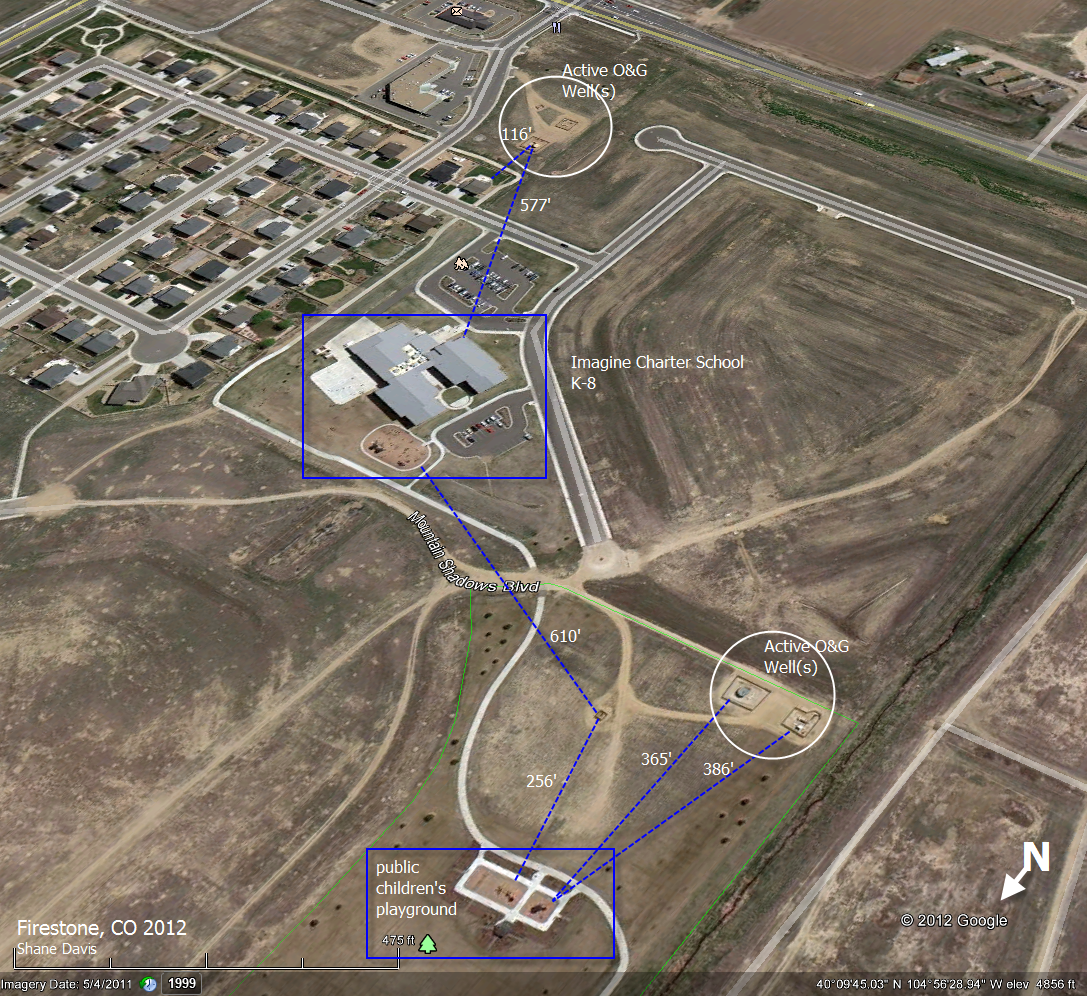
A new study by researchers from the Colorado School of Public Health found that air pollution near natural gas fracking sites increased the risk of significant health problems for people living near drill sites.
The researchers detected a toxic stew of natural gas-related chemicals, including benzene, a known carcinogen, in the air. Exposure to these chemicals is linked to headaches, asthma symptoms, childhood leukemia, and multiple myeloma. They concluded that people living within a half-mile of these drill pads were at greater risk for health problems. Colorado lets companies sink wells as close as 150 feet to people’s houses.

Click image to enlarge
Photo credit: Shane Davis, Sierra Club, Rocky Mountain Chapter


This study confirms reports of hazardous air pollution and related health problems in communities around the country near natural gas fracking. Fracking entails mixing dangerous chemicals with large amounts of water and sand, then injecting this frack cocktail into wells at extremely high pressure in order to release natural gas reserves. This technique has allowed oil and gas companies to access previously out-of-reach reserves.
As a result, natural gas development has swept across many parts of America at break-neck speed in the past ten years. Unfortunately, federal and state safeguards to protect people and the environment from fracking have not kept pace.
Energy companies have been allowed to run roughshod over communities, leaving contaminated drinking water, dirty air, gutted property values, and greater earthquake risk in their wake. Companies don’t always play by the rules that do exist, and the industry has used its political power to escape accountability for its actions.


Continue reading...


Saturday, December 3, 2011

MARK RUFFALO, GASLAND DIRECTOR, JOSH FOX, NEW YORKERS SEND EMERGENCY WATER RELIEF TO PA FRACKING VICTIMS

FOR IMMEDIATE RELEASE:


(NYC & Dimock, PA)— It wasn’t a flood or natural disaster that left more than a dozen families in Dimock, PA without clean drinking water. The disaster in Dimock was caused by the Cabot Oil and Gas Corporation’s use of the hazardous gas drilling method known as fracking. Since 2008 the well water of eleven families has been contaminated with toxic chemicals, flammable gas, and radioactive material.
The Pennsylvania Department of Environmental Conservation found Cabot to be at fault for the contamination, and for the past three years the gas company has been forced to supply weekly deliveries of drinking water to the families. But last month, the PA DEP cut a deal with Cabot, allowing them to stop the water deliveries as of November 30th—leaving the Dimock families with only the toxic, flammable water that has given them headaches and caused skin sores, with the potential for serious long term health effects.

With their last water delivery quickly running out, citizens throughout the region have stepped in to help. On December 6th, Mark Ruffalo, actor and founder of Water Defense, and Gasland Director Josh Fox will join other advocates to deliver clean drinking water from New York State to the eleven Dimock families.

*Press event will be held on the steps of City Hall at 9:30am, with buses bringing NYC water to Dimock, arriving at 2:30pm for second press event.

Who: Mark Ruffalo (The Kids are Alright), Josh Fox (Gasland), Dimock fracking victims, Craig & Julie Sautner, NYC City Council, Manhattan Borough President Scott Stringer, Water Defense, United for Action, National Resources Defense Council, Sierra Club, Food & Water Watch, Catskill Mountainkeeper, and Delaware Riverkeepers

What: Celebrities, Advocates bring pristine New York Water to Dimock, PA fracking victims
Where: NYC Press Event @ 9:30am
Steps of City Hall, Manhattan, NY
Dimock, PA Press Event @ 2:30pm
Home of fracking victims, Craig & Julie Saunter
1101 Carter Road, Dimock, PA
When: Tuesday, December 6th
Schedule:
9:30am NYC Press Event on City Hall Steps
10:30pm Buses with celebrities, advocates bringing NYC water depart for Dimock
2:30pm Dimock, PA Press Conference where advocates will replenish water tanks
###

Monday, August 29, 2011

Frackville, Pennsylvania - REVISIT

Posted June 8, 2010
NRDC

Welcome to Frackville: Natural Gas Drilling Threatening Communities

On June 3, about 100 miles northeast of Pittsburgh, Pennsylvania, a natural gas well “blowout” shot natural gas and drilling fluids 75 feet into the air and onto the ground. As the name makes clear, a “blowout” is the industry’s term for a surge of pressurized oil or gas that causes an eruption -- basically the same thing that caused the explosion and fire at BP’s Deep Horizon offshore drilling platform in the Gulf of Mexico, resulting in the biggest oil spill in U.S. history. Fortunately, there were no injuries from the natural gas blowout. But that doesn't minimize the potential dangers.

“The event at the well site could have been a catastrophic incident that endangered life and property,” John Hanger, secretary of Pennsylvania's Department of Environmental Protection, said in a statement to reporters. “This was not a minor accident, but a serious incident that will be fully investigated by this agency with the appropriate and necessary actions taken quickly.”

Just yesterday there was another explosion 55 miles south of Pittsburgh, in West Virginia, when a crew digging a natural gas well hit a pocket of methane. Also yesterday, in Texas, one worker was killed and several injured when a natural gas pipeline erupted.

On the same day as the blowout last week, I happened to be touring natural gas development not too far away in upstate Pennsylvania. I was in the bucolic township of Dimock, northwest of Scranton, accompanied by NRDC experts and colleagues from the Waterkeeper Alliance. We met with local residents who have learned by hard experience that natural gas drilling is a threat not just to their rural way of life but also to their water supply and their health.

Continue reading...


please comment

CAST YOUR VOTE